Why That “Mystery” Roof Leak Keeps Coming Back to Your Chimney
You had a brown stain show up on the ceiling near the fireplace after the last nor’easter. Someone climbed up, smeared on a little roofing tar, and it was fine. For a while. Then it came back.
Most New Jersey homeowners never hear the real reason. The leak around your chimney usually isn’t the roof at all. It’s the flashing, the metal that seals the joint where the chimney meets the shingles. That’s also why the chimney flashing replacement cost is one of the most Googled roofing questions in NJ. People want to budget for it before they pick up the phone.
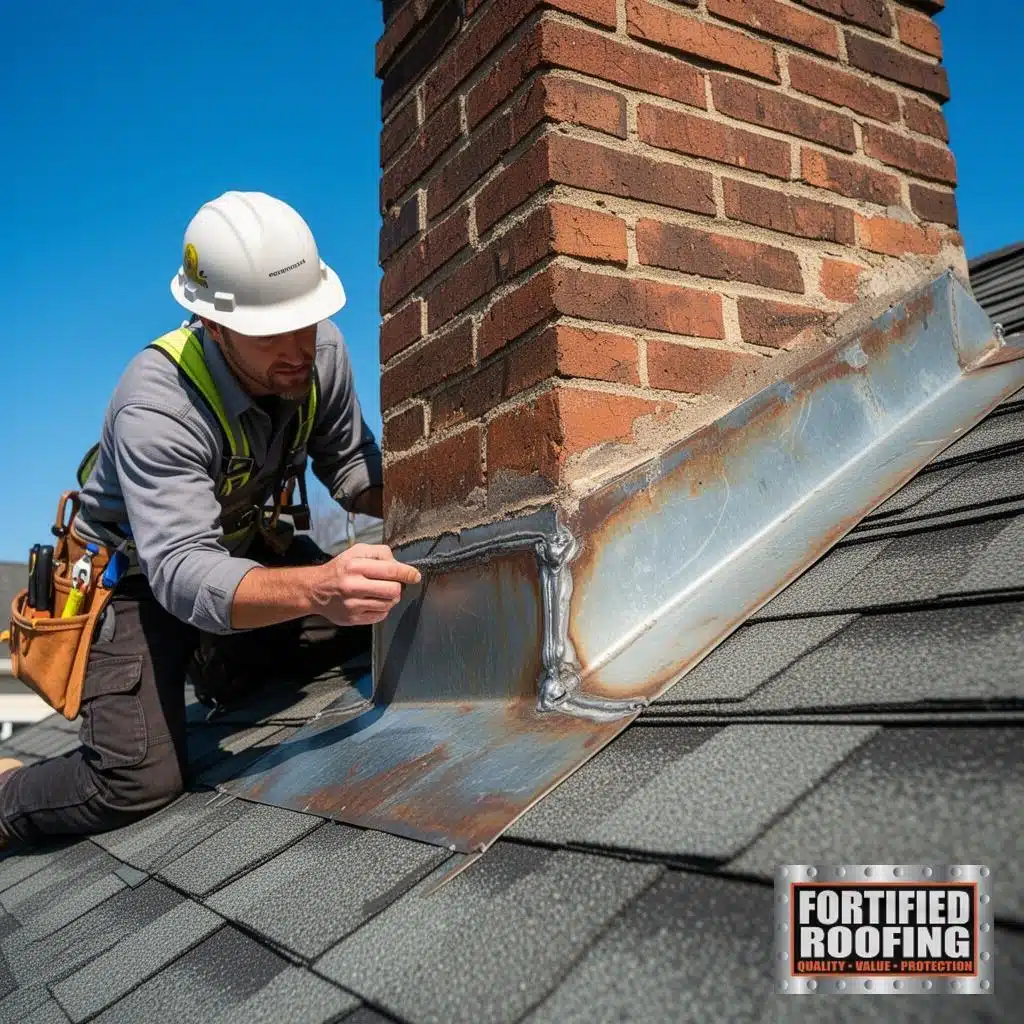
Warning Signs Your Chimney Flashing Is Failing
Flashing does its job out of sight, so most homeowners only learn it failed when water shows up inside. A few signs worth watching for:
- Brown stains or bubbling paint on the ceiling or wall near the chimney, worst after a wind-driven rain.
- A leak that keeps coming back after it was fixed. A recurring chimney leak is almost always flashing, not shingles.
- Rusted, lifted, or separated metal where the chimney meets the roof.
- White chalky staining or crumbling mortar at the joint.
- Daylight or visible gaps along the flashing edge.
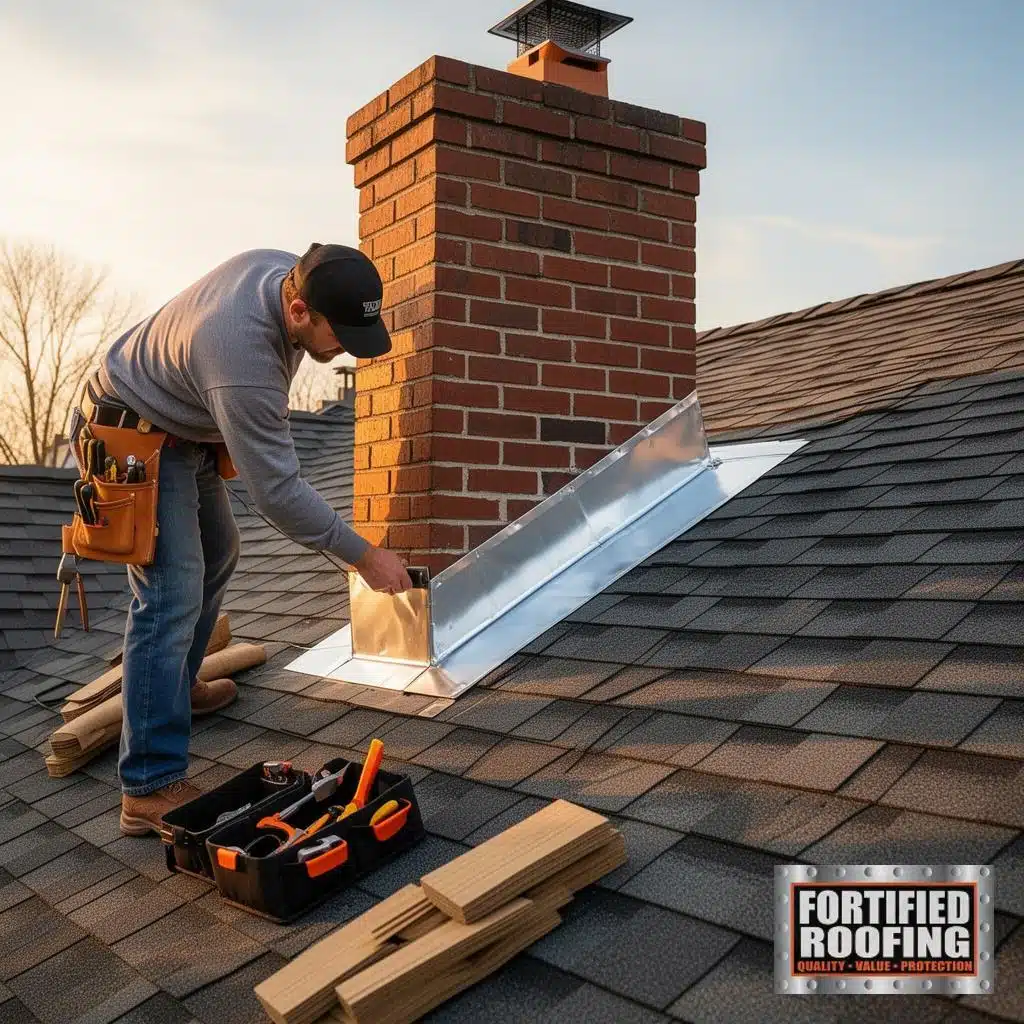
You’ll see two names for that metal on any quote. Step flashing is the row of L-shaped pieces woven into each course of shingles up the sides of the chimney. Counter flashing is the metal tucked into a groove cut in the mortar that folds down over the step flashing. Together, they handle the chimney waterproofing. When either one fails, water slips behind the shingles and travels before it ever drips inside, which is why the stain is rarely right under the actual leak.
More roof-leak calls trace back to a poorly flashed chimney than to any other single problem. If you spot any of these chimney leak repair signs, get it looked at before the water reaches the wood. Our roof and chimney leak repair page walks through how we track down the real source.
What Chimney Flashing Replacement Costs in Monmouth County, NJ
There is no flat price, and that’s the honest answer. Two quotes for the same chimney can land hundreds or thousands apart, and a handful of things drive the gap.
The biggest one is repair versus full replacement. Resealing a sound system costs far less than tearing shingles back and installing new metal. Material is next: aluminum is the budget option, coated or galvanized steel sits in the middle, and copper is the premium pick that holds up best against salt air.
After that, it’s the physical job itself: the chimney’s size and how many sides need flashing, the roof’s pitch and height, and how hard the chimney is to reach. Masonry condition adds labor, too, since cutting fresh counter flashing into the mortar (and any tuckpointing the brick needs first) takes time.
As a rough budgeting range in New Jersey, a straightforward chimney flashing repair often starts in the low hundreds, while a full chimney flashing installation with new step and counter flashing usually runs a few hundred to around $1,500. Add steep or tall access, copper, masonry work, or a cricket (a small, peaked saddle that diverts water on the uphill side of a wide chimney), and the number can climb past $2,000 to $3,000.
Labor is part of why NJ quotes top the national averages you see online, since roofers here generally run about $60 to $95 an hour versus $45 to $70 nationally. That higher roof flashing cost is local, not a markup.
Location matters too. Across Monmouth County, plenty of homes in Middletown, Freehold, Manalapan, and Marlboro went up before the 1990s, when chimney flashing was often sealed with caulk instead of metal counter flashing cut into the mortar. That original flashing is usually past resealing and due for full replacement.
On the bayshore and oceanfront, salt air eats cheaper aluminum faster, so a lot of those homes move up to steel or copper. Our Monmouth County roofing hub covers more of these local patterns.
Repair vs. Replace: Reading a Chimney Flashing Quote Like an Insider
The test is simpler than most people expect. If the metal is sound and only the top seal has gone, a reseal can buy you years. If the flashing is rusted, the counter flashing was only caulked on, or the leak keeps returning, replacement is the call.
Caulk smeared over old flashing typically fails in 2 to 5 years, while properly installed metal step and counter flashing lasts decades. Those are the chimney leak repair or replacement signs worth knowing before anyone hands you a price.
|
Your situation |
Best move |
Relative cost |
How long does it last |
|---|---|---|---|
|
Metal sound, top seal cracked |
Reseal/repair |
$ |
A few years |
|
Rusted or caulk-only flashing |
Full replacement |
$$ |
20 to 30 years |
|
Recurring leak, soaked decking |
Replace flashing + repair deck |
$$$ |
20 to 30 years |
A legitimate quote to replace chimney flashing should itemize the work, not hide it in one line. Look for the removal of old flashing and sealant, new step flashing, and new counter flashing cut and sealed into the mortar. The quote should also list base flashing on the downhill side, shingle re-integration, a masonry allowance if the brick needs it, and the warranty name and length. If a line is missing, that’s the question to ask before you sign.
So why do two quotes for the same job differ by so much? Usually, the crew structure and approach. One contractor caulks the old metal and moves on; another installs proper two-piece flashing and charges for the labor it takes. A roofer who subcontracts the work also adds a markup that an in-house crew doesn’t carry. As a GAF Master Elite contractor (top 3% nationally), Fortified Roofing handles roof flashing replacement with our own crews, which is a big part of why the repair holds.
One more number worth running. The cheapest patch isn’t cheap if it leaks again, because recurring water rots the decking (the plywood under your shingles) and the framing, and that turns a flashing repair into a full roof repair or replacement. Doing it right once is the smaller number over the life of the roof.
Stop the Leak Before It Becomes a Roof Repair
If there’s a stain near your chimney, the smart move is to look before the next storm, not after. Fortified Roofing has sealed roofs and chimneys across Monmouth County and central New Jersey since 2001. A live person answers every call, and we run a magnetic-sweep cleanup before we leave.
Protect Your Home With Trusted Roofing Experts in New Jersey
If you’re unsure about your roof’s condition, don’t wait for minor issues to turn into major damage. Fortified Roofing provides professional roof inspections, roof replacements, repairs, and solar roofing solutions throughout New Jersey. Whether your roof has storm damage, aging shingles, leaks, or you simply want peace of mind, our experienced team is here to help.
Led by roofing expert John Kabourakis, Fortified Roofing is committed to delivering honest recommendations, quality craftsmanship, and long-lasting roofing systems designed to protect your home and investment.
Call us today at (215) 260-8111 or contact our team online to schedule your inspection or request a free estimate.
Our Roofing & Exterior Services
- Roof Replacement
- Roof Repair
- Storm Damage Roof Repair
- Roof Inspections
- Solar Roofing Solutions
- Siding Installation & Repair
- Gutter Services
FAQ
How much does it cost to replace flashing on a chimney in NJ?
There is no single number. A simple repair can start in the low hundreds, while a full replacement with new step and counter flashing typically runs a few hundred to about $1,500. Copper, steep or tall access, masonry repair, or a cricket on a wide chimney pushes it higher. The only accurate figure comes from an in-person inspection.
Can chimney flashing be repaired, or does it need full replacement?
It depends on the condition. If the metal is sound and only the top seal fails, a reseal can work. If the flashing is rusted, only caulked in place, or the leak keeps coming back, replacement is the better value. A good roofer should be able to show you what you’re dealing with.
Why does my chimney only leak in heavy or wind-driven rain?
Because the water gets pushed sideways into gaps that a straight-down rain misses. Wind-driven rain finds the weak spot behind failing step or counter flashing, runs down inside the structure, and shows up as a stain that can sit several feet from the actual entry point.
Do I need a permit to replace chimney flashing in New Jersey?
Usually no. NJ treats like-for-like roof covering repair, which includes routine chimney flashing work, as ordinary maintenance under N.J.A.C. 5:23-2.7, so no permit is required in the standard case. Structural changes, sheathing replacement, or masonry rebuilding can trigger one. You can confirm the current rule on the NJ DCA code site, and a reputable roofer will pull a permit when the job actually calls for it.